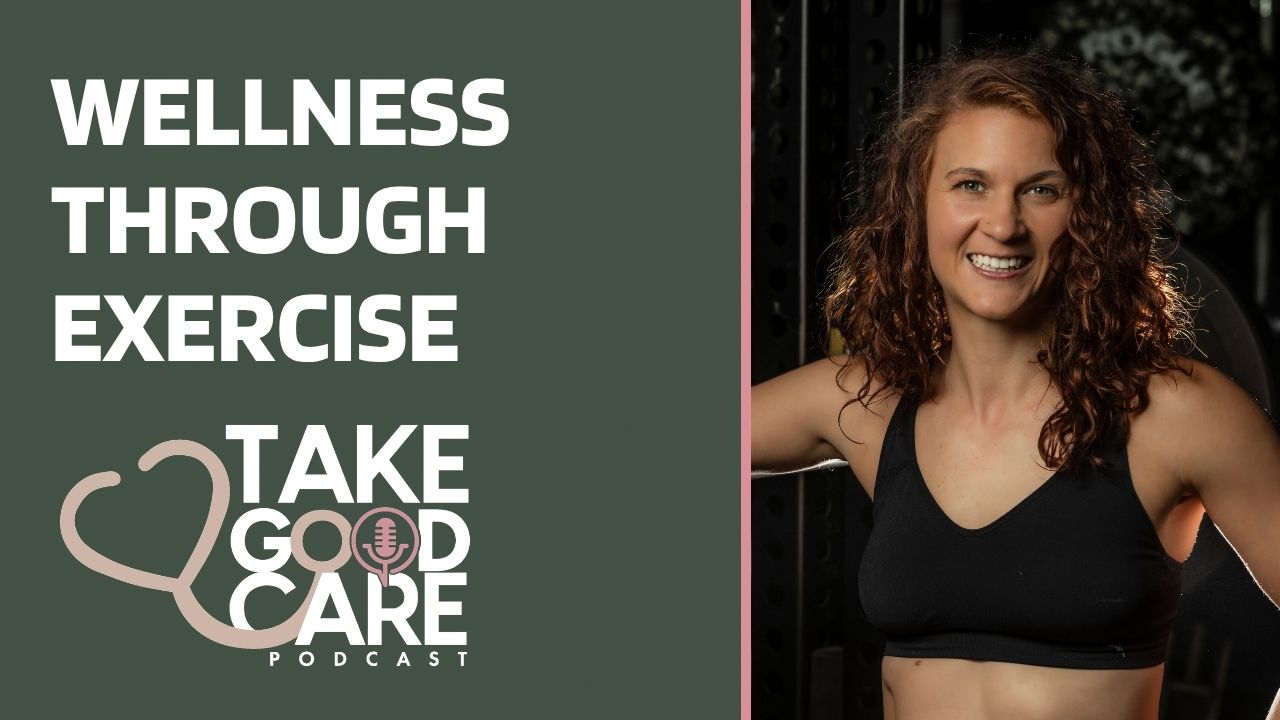

Wellness Through Exercise with LaurieAnn Harper
In this episode of the Take Good Care Podcast, Drs. Mironda Williams, Deanna Guthrie, and Karen Greene step outside the studio and head to RG Fitness in Peachtree City to sit down with trainer LaurieAnn Harper. LaurieAnn shares her unconventional path into fitness. A former social worker and mother of three, she discovered strength training only after experiencing a year of postpartum depression following her third child. She describes how exercise didn’t change her circumstances but fundamentally changed her mindset, turning overwhelming problems into manageable ones.
The conversation explores exercise as a form of mental healthcare as much as physical care, with each guest sharing her own journey into fitness, from Dr. Greene’s late start with running to Dr. Guthrie’s evolution from step classes to running to cycling. LaurieAnn addresses common myths around strength training for women, particularly the fear of “bulking up,” explaining that building muscle also protects bone density and heart health, especially as women age. She emphasizes that meaningful physical transformation requires significant, deliberate effort (calorie surpluses, dedicated training) that doesn’t happen accidentally.
The discussion closes with practical guidance on motivation and consistency. LaurieAnn notes that motivation is temporary but habits are durable, and she recommends committing to just 30 days to build a sustainable routine. The doctors and LaurieAnn encourage listeners to reframe exercise around long-term health and identity (“aging like wine”) rather than external appearance goals, and to find a supportive community and workout style that feels sustainable and even enjoyable, rather than punishing.
Dr. Mironda Williams: Welcome to Take Good Care podcast.
Dr. Deanna Guthrie: An endeavor that grew out of our love for obstetrics and gynecology.
Dr. Karen Greene: Our aim and mission is to serve as a source of vital information for women of all races, ages, and walks in life.
Dr. Mironda Williams: I am Dr. Mironda Williams.
Dr. Deanna Guthrie: I am Dr. Deanna Guthrie.
Dr. Karen Greene: And I am Dr. Karen Greene.
Dr. Mironda Williams: Welcome to our show.
Dr. Karen Greene: Welcome to our show.
Dr. Deanna Guthrie: Welcome to our show.
Dr. Mironda Williams: Welcome to this episode of Take Good Care Podcast. I’m Dr. Mironda Williams.
Dr. Deanna Guthrie: I’m Dr. Deanna Guthrie.
Dr. Karen Greene: And I am Dr. Karen Greene.
Dr. Mironda Williams: And we, for the first time, are out of the studio and we are on site. We are here at RG Fitness with Ms. LaurieAnn that you guys are going to hear about shortly in terms of how she got into this whole exercise, fitness, wellness type of thing. But, Karen, why don’t you kind of get us started talking about how we even connected with this lovely lady?
Dr. Karen Greene: Thank you, Mironda. I joined a gym probably, I don’t know, maybe it was about two, three years ago. And one of the classes was Tabata. I had never heard of what Tabata was. And so a friend of mine, Anika, she said, “Well, if this is what you do and that’s what you do, you would love it.” And I was like, “Well, okay, I’ll try it out.” “And it’s a woman instructor.” So I was like, “Okay, great.” Because she said, “It uses weights. We use a bench.” I was like, “Okay, so it’s like a step class.” “No, it’s not a step class,” but said, “But it uses different things.” And I was like, “Okay, this sounds like fun.” So I would go, I can’t remember what day it was and Lori Ann was the instructor.
And the thing I liked about it was the fact that it was mostly women in the class. She was very encouraging and she’d make you do more and you wouldn’t feel silly about doing more. And so we were talking about some of our pillars in terms of women’s health. And I said, “We should get a woman instructor in physical therapy or physical training to come to our podcast. What about LaurieAnn?” And at the time she had left the gym that I was at, but my common contact, she said, “Well, I’ve got her telephone number. We can call.” So we contacted Lori Ann and as we’re talking about it, and I don’t remember, how did this come out where I was talking to Dr. Guthrie about it?
Dr. Deanna Guthrie: I don’t remember either.
Dr. Karen Greene: About what the gym was. I don’t know who. I can’t remember how we all realized that we had multiple connections.
Deanna Guthrie: I think Connie came in and said, “I hear y’all are coming to my gym.” And I was like, “What gym?”
Karen Greene: That was it. That was it.
Dr. Deanna Guthrie: And she goes, “Deanna, RG Fitness is my gym.”
Dr. Mironda Williams: Give the audience a little bit more about Connie, who she is.
Dr. Deanna Guthrie: So Connie was the owner of RG Fitness. She’s one of my patients and long-term patient. And so one day she came in and we were just kind of talking and she said, “Oh, I am so excited. I hear you guys are coming to my gym.” And I knew she had a gym. And so she was just explaining how we had gotten in contact with LaurieAnn and we were going to do the fitness class. So I was like, “Yeah.” Full circle.
Dr. Karen Greene: And that was actually a year ago. That was a year ago.
Dr. Mironda Williams: So we had this planned and then life happens and so we had to reschedule and everything in divine timing because this is actually the absolute-
Dr. Karen Greene: The better time. Yes.
Dr. Mironda Williams: The better time for this to happen. And, Dr. Guthrie, go ahead and talk a little bit more about our pillar and then we’ll let Lori kind of get into how she got into this.
Dr. Deanna Guthrie: So we have pillars of health that we focus on with Rosa Gynecology. And this segment here fits in perfectly with two of our pillars. One is body care, which of course physical fitness will fit into, and emotional care because working out, being fit also helps with stress and mental fitness and things like that.
LaurieAnn Harper: I always like to joke that I don’t make a decision before a workout. Don’t kill anybody. You’re not leaving your man, you’re not leaving your husband. The kids are worth it. And for sure after the workout, we don’t make any decisions till after the workout. And I also like to say that I emotionally can feel, you know when you go on vacation or something like that, I do take time off for myself and I give my body a rest, but emotionally and just mentally I can tell the difference. Exercise is a pillar in my life because of how it affects me positively mindset-wise. So I feel like yes, obviously body care, but we don’t understand and we really, I wish we understood and focused more on how it is mental healthcare for sure.
Dr. Karen Greene: How did you get started to become a trainer because I’m sure you did?
LaurieAnn Harper: Well, it involves Connie. It is kind of a crazy story. It’s kind of funny because my background is not fitness. I was a social worker. I went to school. I was a sociology major. I was a social worker. I’d like to say that was my big girl job before I had to retire to have kids. And anyway, and so I used to feel very self-conscious that because I didn’t have a bachelor’s in science, that held me back. But really, I think one of my greatest strengths as a trainer and a woman trainer and a mom woman trainer is that I didn’t start young. I was fit. I’ve been in sports and I knew that being in shape was good, but I didn’t start all of this until after I had my third child. And so basically, to tell you the truth, my foray into fitness started, like I said, really understanding the importance of it started after having kids.
And after my first baby, that six-week mark I got cleared, I was exercising. Second baby, same thing. I was always back to my birth weight. That was just something I had decided on. Some women, they have different strategies. But it wasn’t until my third baby when I was like, “Well, I’m not having anymore. So let’s not push myself to get…” Well, I ended up going into, I’ll call it baby blues postpartum for a year.
Dr. Mironda Williams: Wow.
Dr. Karen Greene: Wow.
LaurieAnn Harper: And I didn’t even realize what it was because the sensational stuff makes the headlines like somebody hurt her children or things like that. And that’s what you think it is. But it wasn’t. It was me feeling like I said, I told my family, I said, “It feels like I’m in a swamp every day of my life. Thinking is slow. Moving is slow. Everything is just slow and I’m tired. I’m very, very, very tired by the end of the day. And I lost me. I lost who I was.”
Dr. Mironda Williams: LaurieAnn, I’m so glad that you were just talking about the mental health benefits and also your experience after your third child and experiencing the baby blues or postpartum depression, because to your point, I do think women think that, “Unless I have these drastic feelings, I’m not really experiencing that,” and it doesn’t have to be that sensational. And I think that’s one of the things that both you and Dr. Guthrie and Dr. Greene have in common in terms of the mental health benefits of exercise and how it helps you to process mentally, or not to process, just let your mind be blank while you’re exercising. So continue to talk a little bit more about that.
LaurieAnn Harper: Sure. And so at the time in 2018, I had friends that had joined a local gym and they had encouraged me to do it. The gyms that are out these days we have thankfully group fitness has become more of a thing. Going to a box gym and just finding a group class wasn’t for me at the time. So anyway, I’m at this gym and I realized I did like a six-week trial. And I realized at the end of that six weeks, my problems hadn’t changed, but my mind had changed. I literally was driving through and I was like, “This is crazy because I’m so happy.” And you have to understand happy was, it wasn’t necessarily like yay happy. It was just, “I’m okay.” None of my problems had changed. The things me and my husband were having issues over or me and the children, none of that had changed. It was just not overwhelming anymore.
Dr. Mironda Williams: And that’s so good because life happens, right?
Dr. Karen Greene: Yeah.
Dr. Mironda Williams: There’s never a perfect situation where everything’s working out, but if your mind is able to just handle it and be able to continue, because Dr. Greene says all the time that, “I run to eat, but not just that, I run because I would hurt somebody [inaudible 00:08:26].”
LaurieAnn Harper: Endorphins.
Dr. Mironda Williams: Most of you all do talk about that a lot because you all have been exercise enthusiasts pretty much your whole life, right? Because I know you were an athlete track.
Dr. Karen Greene: A little bit. Yeah.
Dr. Mironda Williams: But I’m saying you were physically active.
Dr. Karen Greene: Right. And I’ve always been.
Dr. Mironda Williams: You were doing physically active things, I guess.
Dr. Karen Greene: Yeah.
Dr. Mironda Williams: But I know you came to the other stuff.
Dr. Karen Greene: I came to exercising late. I think because-
Dr. Mironda Williams: And when you say late, give us an idea of [inaudible 00:08:53].
Dr. Karen Greene: It occurred to me that when I was in my probably 30s that I’m lucky now that I don’t have to do much to keep my current weight. But one day I’m going to have kids and I’ll be a lot older because I’m 30 now and I didn’t have any kids.
Dr. Mironda Williams: This pre-babies.
Dr. Karen Greene: This is pre-babies.
Dr. Mironda Williams: Okay.
Dr. Karen Greene: And so I started doing some minimal exercise stuff. And it occurred to me at that point that it was like, “Okay, this is going to…” Because you know as a physician, you know this is important. But for me it was a sudden occurrence that in my mind I needed to do more. And then as a result, I realized how it affected me. And so it became important and I didn’t expect it to become important because when I started running, I was like, “Me run? I don’t know about that. I’m old enough to have the physical fitness challenges you had to do in high school and you had to do it every year and that running part I hated.” And then I realized when I started running, I was like, “There’s a point in the run where actually I’m enjoying myself.” And so that enjoyment that Lori Ann talks about has to do a lot with your mental wellbeing and that kind of silently thing and making things calmer that you’re like, “Okay, now I can do stuff.”
Dr. Mironda Williams: Where you just kind of zen out? What about you, Dr. Guthrie?
Dr. Deanna Guthrie: So I started really exercising right out of college and it was when those step classes were real popular.
Dr. Mironda Williams: Oh, yeah, you were a step queen.
Dr. Deanna Guthrie: And I was in medical school, so you really need it.
Dr. Mironda Williams: Okay. Yeah.
Dr. Deanna Guthrie: So you needed that mental break. And I just always remember that I always felt better after every… No matter how bad I felt before class, how tired I was before class, if I was dragging myself out of bed to go to class. So I wasn’t a morning person back then. I was an evening class person. But I always felt better after class.
Dr. Mironda Williams: And when you say felt better, describe that mentally, physically, all the operations.
Dr. Deanna Guthrie: Clearer mentally. You felt like you did something.
Dr. Mironda Williams: So you felt accomplishment.
Dr. Deanna Guthrie: You could feel the accomplishment. You felt the energy from what you just did. And so I would always tell myself, “Just get to the workout and it’s going to be okay.”
Dr. Karen Greene: It’s going to be okay.
Dr. Deanna Guthrie: And then for me too, I kind of graduated into what I did. So step was first. I would hate running too. I had a friend of mine who tried to get me to running and I hated it. But then one day I decided, “You know what? I’m just going to do the Peachtree for fun.” And I’d never really run before, so I mapped out two miles from my house and I was surprised that I did it in a relatively short period of time. So then I got into running. Then I always said to somebody, “Oh, it’s cycling. It’s just probably boring. You just kind of just peddling. Nope.” Next thing on the list was cycling. Now cycling 30 miles, things like that. So it’s kind of been a stepwise journey kind of discovering things all along the way. And again, just that sense of accomplishment, kind of challenging myself. I’m not competitive necessarily with other people, though I can be, but just challenging myself and hitting runs of goals, that sort of thing.
Dr. Mironda Williams: How did you get into the weight training part? How did that happen?
LaurieAnn Harper: That is a great question. So it was progressive. Like I said, the gym I was at when I first started getting back into shape, they had style training and in that it was weights. And it was the trainer there at the time, which Connie was one of the trainers there, it was, “Oh, that 12 and a half looks cute on you if you ever hear me say that.” And that just resonated. I mean, and I’ll never forget, there was one time where everybody had taken my 15s that I wanted. And so I had to pick up a 20 and then I’m like, “Oh, I’ll do this until the 15.” The trainer goes, “Nope, you can stay right there. That 20 looks good on you.” And I-
Dr. Mironda Williams: Now I get it.
LaurieAnn Harper: Those little gifts that were given to me, I like to, that’s a pay it forward.
Dr. Mironda Williams: Yeah, share.
LaurieAnn Harper: I like to share that. But there’s something magical about it. When you pick up something that you didn’t think you could pick up, even if it was 15 minutes ago when the class started, and then you got done with it and yes, it was hard and it was uncomfortable, but there are things now that people don’t realize is that translates outside of your life. And it’s like, “Okay, this is going to be hard. This is going to be scary, but we’re going to do it.” I tell people a lot of times, I might have even said it in Tabata, “This is a metaphor. What happens inside these four walls, you get down, you get up. Something was heavy, you deal with it and then you put it down and you keep going and you don’t quit. You don’t walk out those four walls until you’re done with what you need to do.” But sorry, I’ll go off on tangents.
Dr. Mironda Williams: No, no, no. I like it. And also, because Dr. Greene is always encouraging me, “Lift heavy, you can lift heavy.” Talk about how you encourage or especially as it relates to women doing the weight training, the physical benefits, the mental benefits, especially as we age and continue to live life?
LaurieAnn Harper: Yes. And to just quickly answer that last question because I went off, the barbell, which is something that I’m very passionate about these days, is something that I got introduced to at Coach Connie when I went to her gym and then eventually was hired at the gym that she owns now. And I’ll definitely talk about that later. But in women’s health there is so… This is difficult because I don’t want people who have smaller frames to feel like they are not included in this conversation. But in culture, certain cultures, being small is celebrated. And I mean, I feel like for most women, if you do the bell shape curve, for most women, because of life, we start taking up space. I mean, physically.
Dr. Karen Greene: That’s what I say.
LaurieAnn Harper: My hands took up this much space and then I had three kids and they took up this much space.
Dr. Mironda Williams: Yes. I like that phrase.
LaurieAnn Harper: And that is the amazing part about aging is that thankfully our brains grow with our bodies and we realize, “Oh, yeah, I’m going to take up that whole space and feel uncomfortable with all of it.” Or if you don’t like it, feel uncomfortable with it. And hopefully you find the people like I did with my coach who there was one time in a meeting, she goes, “No, speak, be loud, tell me what you want. I want to hear your voice.” And so being in those kind of communities is amazing. But yes, strength training in that building your muscles is also building your heart. It’s also protecting your bones. I cannot speak enough about osteoporosis and how much it plagues women as we get to our age. And the best way to fight that is if you do a thousand sets with tens, that’s not fighting it. We got to pick up. We got to go next time and we got to… And thankfully we got the 12 and a halves. We don’t have to go up to 20.
Dr. Mironda Williams: We have the weight?
LaurieAnn Harper: All right? Yeah. If the tens are all taken, I can hand you a 12 and a half these days. You don’t have to go all the way up to 20 like I did.
Dr. Deanna Guthrie: And what about the myth that if you do weights, you’re going to just bulk up and look like-
LaurieAnn Harper: I mean, I’ve been strength training for six years now. Number one, this is the frame that I was born with. So yes, I have strengthened it, but the women that people-
Dr. Deanna Guthrie: Picture.
LaurieAnn Harper: … picture. I will say strong men competitions, a lot of those are bigger framed women, period. That is the frame that God gave them. They’re not going to be able to go down. You what I’m saying? You need to be the best at whatever God created you in that. And so that being said, also there’s performance-enhancing supplements and materials that make women, that get them to a different place. I don’t take them so I don’t speak on them, but that’s just something that would do it too. But unless you’re at home eating the amount of protein you need to be eating and training like you need to train, you’re going to get muscular, but you are not going-
Dr. Mironda Williams: It’ll still be a woman’s body?
LaurieAnn Harper: Yeah.
Dr. Deanna Guthrie: I think that’s what a lot men may be afraid of, they don’t want [inaudible 00:17:24].
LaurieAnn Harper: And a lot of women who are at what we call jacked or who are at that level are like, “I would love for you to train the way that I’m training. I would love for you to eat…” I mean, we’re talking about a calorie surplus of thousands that we normally… And that takes coaching and time and you’re just not going to wind up there one day. I will say women did come up to me when I did class at Piedmont and there’s one woman and she was like, “How do I get arms like yours?” And I was like, “Five days a week training.”
Dr. Mironda Williams: Just consistently.
LaurieAnn Harper: And she goes, “Well, we’ll try it.”
Dr. Mironda Williams: Consistency. Yeah.
LaurieAnn Harper: But when I say arms like this, I mean my bicep is like 10, 11 inches. We’re not going for 16 inches. That’s not happening overnight.
Dr. Mironda Williams: That’s great. And again, just as a reminder to our audience, we are not in the studio. We’re still live.
LaurieAnn Harper: We’re in a gym.
Dr. Mironda Williams: But we’re in a gym. We’re at RG Fitness. I just want to let people know this gym’s located in Peachtree City, Georgia on Georgia State 74, Suite 104. It’s behind the Mellow Mushroom.
LaurieAnn Harper: Mellow Mushroom.
Dr. Mironda Williams: We’re used to that. And I want the audience to stay tuned because we are actually going to talk about it and then we’re going to be about it. We’re going to actually move into some weight lifting training with our wonderful coach here. And this is just from the time we pulled up in the parking lot and came to the front door, you could just feel the kind of spirit and energy that’s here in this gym. Very welcoming, very affirming, very supportive. I exercise for health benefits, but I have struggled with just the motivation to really stick with something and to be consistent. And so how do you help people stay motivated or become motivated? And do you have any things that you use to help people like me?
LaurieAnn Harper: As a trainer, I’ll let you know that’s one of our biggest hurdles. And when I did personal training, people would ask me, I would be like, “Listen, you’re hiring me. That’s a financial investment. If you want to stay motivated, I think first you should… I am very, look at my bank account. I pay this amount of money. I want to get my…” That’s just the way I am. But there is for trainers and thankfully there’s a whole new, there’s a slew of moms just like me and trainers who love what we do and we know where you were at and we know where you can be. But there’s still, you can lead a horse to water, right?
Dr. Mironda Williams: Yeah.
LaurieAnn Harper: So, motivation. We like to remind people motivation is temporary. It only lasts as so far as maybe you got that picture up on that mirror at home and then you’re out of the home and you forget that picture. Motivation is temporary. A habit becomes in place. Is it about 30 days if you give yourself 30 days? And I think a smart thing to do is set for yourself 30 days and be strict about it for… I’m not saying be strict about it for forever because once again, then we’re going on back to mental health issues. But have a habit for 30 days. When I was getting into working out, at the time I was a stay-at-home mother. I still am. Just do a lot of other things. But when I was just getting back into it, I made a promise to myself, every Monday I would work out. This class was offered at 4:45 AM.
I didn’t need to be at that class at 4:45 AM. I could pick other classes. But for me, it started my first day for me. I know Sunday’s the first day, but for me, my first work day, it was the first thing I did. And that set the tone for my week, which was hard work and what do you want? And so for people who need that motivation, I would say get to your discipline as fast as you can. Get to that discipline as fast as you can because eventually… And so you guys are doctors.
I like to tell people that doctors do tell people, “Oh, well we’d like you to exercise what, two to three days a week?” And I’ll tell my clients, “Your doctor’s telling you that because they know that you’re only going to do it one day a week. They want you to get to two days. They want you to…” I said, “You need to get to four to five days.” I said, “Your doctor’s just trying to get you in the gym, so hopefully you will keep going.” I said, “If I’m being real honest with you, four to five days of exercise. Now, does it need to be the same thing? Does it move your body?”
And so the motivation, you got to find… Everybody’s different for everybody. For me, my motivation comes from mental health. Number two, as a trainer now, I’ve got a lot of accountability around me. I do not want to be the reason why somebody doesn’t go to the gym because Coach Ellie didn’t go to the gym today. So I know that that’s unique to me and that’s probably unique to trainers, but I do feel responsibility to that. And I know Coach Kyan, that’s a culture we carry in our gym. So I don’t feel that, that’s not from the top down. That’s what makes us so great is that we believe all the same tenants like that. And for me, I wanted to age like wine.
Dr. Karen Greene: That’s a great goal and I have the same one.
LaurieAnn Harper: Yes.
Dr. Mironda Williams: I like that because I think it’s so important when we talk about motivation and being able to maintain consistency is to get away from the external. Because I think a lot of people think, “Oh, I’m working out because I want to get to a certain size. I’m working out because whatever, society says I should look like X, Z, P, D, Q.” And what I hear you saying and what we try to tell ourselves, because we try to practice what we preach, but also to let our patients know and empower them, move for yourself however that is, move and move your body. And it does need to be, even though we tell you just get there a couple, three times a week, it does need to be at least five days a week. That’s what the studies have shown, that if you’re really going to be able to gain the benefits from whatever you’re doing and to keep that paying forward in the future, we talk about some of the things that we’re doing.
I talk to my partners all the time. I’m making decisions now in my 60s so that my 70s will look better, and then in my 70s so that my 80s will look better. And that’s the whole concept behind the healthy movement exercise, the kinds of things that we try to do individually. And then what we try to encourage our patients and others to do through this podcast, which is to find what you can do where you are moving your body in a healthy way and do it because you want to be healthy and age like wine. I think that’s an excellent way to segue because we’re getting ready to work on aging like wine. So again, are there social media handles or anything where our audience can find RG online or do some things?
LaurieAnn Harper: Yes.
Dr. Mironda Williams: Can you just let everybody know what that is?
LaurieAnn Harper: Absolutely. So our Instagram is RG Fitness. You just go into the search bar and you type in RG Fitness. We have a Facebook page as well. But I think that the best information you’re going to get is on the Instagram page right there. We got links to the websites so you can go, if you want to try a free class with us, we would love to. You get a free class, come on in, check it out. We want you guys to hear. And honestly, we stand on that one free class. I can’t tell you how many times we’re like… And here’s another personal thing. Not everybody’s like this. I need it to be fun. We have fun here.
We’re not training for the Olympics so we don’t necessarily need to be pushing through and not having a smile on our face. If we can’t feel proud of ourselves, then yes, do hard things and at the same time just laugh at what’s going on and do I hold a serious class? Absolutely. You’ve taken my classes. It’s serious in that there’s regimen in, but am I going to push you? Yes, but also are you going to end up going, “Did she say that?”
Dr. Deanna Guthrie: Did I just hear that?
Dr. Karen Greene: I think that speaks to people have to find where they fit in. They have to find something that, as you said, are motivated to come back to. And a lot of women are afraid of going to gyms because there’s so many other people that seem to look like they know what they’re doing and you feel out of place. And so if you can find a place and a free class, I think that’s a wonderful opportunity to just take advantage and find a community, as you said earlier, that you can be a part of and you say, “Okay, this is fun and I’m getting something done. I think I’ll be back.”
Dr. Deanna Guthrie: Yeah. There’s so many different types of workouts now that everybody I think has the picture of the big box gym and people feel intimidated walking in, like you said, and, “What do I do? I don’t know what to do.” Everybody in there is looking cute with their cute outfits. They’re matching tops and bottoms and things like that. But there’s so many different workouts that are out there and group classes where you can meet people, fit in, become social for some people, keeps you encouraged.
Dr. Mironda Williams: Yeah. Great, great. So we are winding down this episode of Take Good Care podcast. For those of you who follow us on YouTube, make sure you get the video because we’re about to pump some iron. So please stay tuned. Share this with all your family and friends and thank you always for coming to take these trips with us in Take Good Care podcast. Stay tuned. We got more stuff coming. So until we meet again and stay tuned for the next episode, I’m Dr. Mironda Williams.
Dr. Deanna Guthrie: I’m Dr. Deanna Guthrie.
Dr. Karen Greene: And I am Dr. Karen Greene. Take good care.